On 14 August, the UK ordered every disposable barbecue off shelves and websites in Great Britain: the rule has no fixed end date, only a review clause tied to the weather forecast
On 14 August 2026, the UK's Office for Product Safety and Standards (OPSS) published statutory guidance stating that disposable barbecues “cannot be considered a safe product in the context of the ongoing weather and environmental conditions, and must not be made available for sale either in store or online at the current time.” Most coverage treated this as a wildfire-season news story: hot, dry weather, fire risk, a sensible precaution. What that framing misses is the compliance mechanism underneath it. OPSS did not write a new rule. It used the General Product Safety Regulations 2005, a 21-year-old instrument, to declare an entire, otherwise correctly manufactured product category unsafe because of a condition external to the product itself: the weather. No product recall, no defect, no design change, and no calendar date for when that status reverses.
A weather condition, not a product defect, triggers the ban
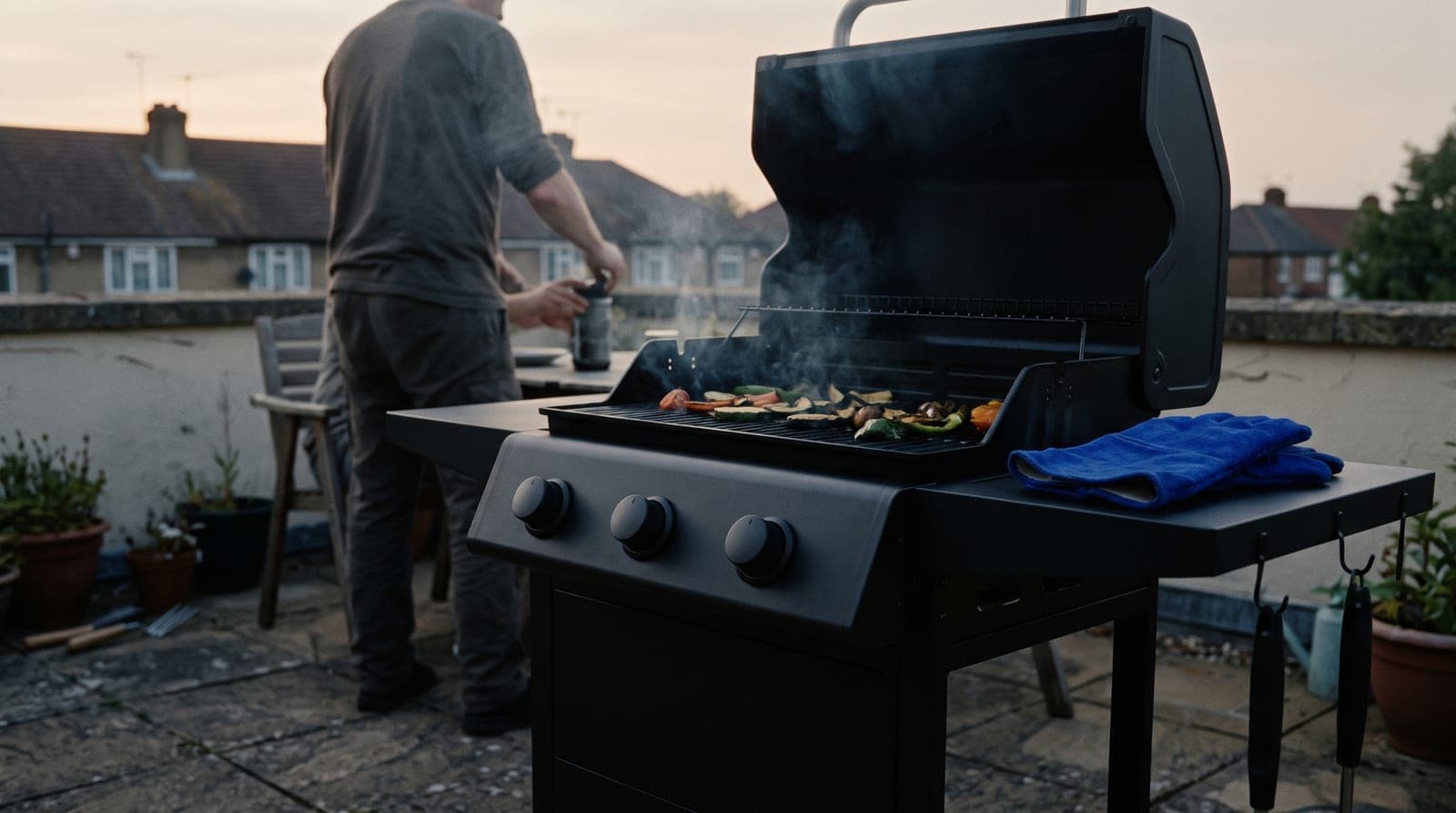
The General Product Safety Regulations 2005 (GPSR 2005) is the retained UK regulation that requires anyone who supplies a product to place only safe products on the market, and to withdraw or recall those that are not. It is a separate, older instrument from the EU's General Product Safety Regulation (2023/988), which the UK does not follow post-Brexit. On 14 August 2026, facing prolonged drought and heatwave conditions, OPSS issued statutory guidance under GPSR 2005 covering domestic single-use outdoor barbecues, defined as units with a fuel tray, grill grid and charcoal that are not intended for refill or reuse. The guidance states these products cannot currently be considered safe and instructs retailers and online sellers not to supply them, in store or online, while the guidance is in force. Failing to follow it is treated as a breach of GPSR 2005, enforceable by OPSS and by Local Authority Trading Standards, with sanctions that include criminal penalties. The guidance covers England, Scotland and Wales; Northern Ireland is not covered by GPSR 2005 in the same way and is outside the guidance's scope.
Three nuances that separate signal from noise
01
The product did not change, the environment did
No design flaw, recall or new standard triggered this. A disposable barbecue legally sellable on 13 August became unsellable on 14 August because of drought and heatwave conditions the guidance itself names as the reason.
02
No end date, only a review condition
The guidance sets no calendar date for withdrawal. OPSS has said it will keep the guidance under review and withdraw it, in consultation with other departments and agencies, once weather conditions change enough to significantly reduce the risk.
03
Three nations covered, one left out, one across a different border doing it voluntarily
England, Scotland and Wales are bound by statutory guidance with criminal sanctions attached. Northern Ireland is outside it. The separate state of Ireland only asked retailers to voluntarily pause sales in July 2026, with no legal requirement behind the request.
Mid-Jul 2026
As heatwave and wildfire warnings spread across Britain and Ireland, Ireland's fire services and retailers ask sellers to voluntarily pause disposable barbecue sales. No legal instrument backs the request.
14 Aug 2026
OPSS publishes statutory guidance under GPSR 2005 for England, Scotland and Wales: disposable barbecues must not be supplied in store or online while drought and heatwave conditions persist.
From 14 Aug 2026
Retailers, including major grocery and DIY chains, remove disposable barbecues from sale in Great Britain. OPSS and Local Authority Trading Standards hold enforcement powers, with criminal sanctions available for breaches.
No fixed date
The guidance remains in force until OPSS, in consultation with other departments and agencies, determines that weather conditions have changed enough to significantly reduce the risk.
The numbers behind 14 August
One number is how old the regulation being repurposed for this is. One is how many of the UK's constituent nations the guidance actually binds. The third is how many calendar days the guidance guarantees before it can be lifted.
21 years
the age of the General Product Safety Regulations 2005, the instrument OPSS used on 14 August 2026 to suspend supply of an entire product category over weather conditions, not a product defect
3 of 4
UK nations bound by the statutory guidance: England, Scotland and Wales are covered; Northern Ireland is not
0
calendar days guaranteed before the guidance can be withdrawn: OPSS ties withdrawal to a weather-conditions review, not a fixed date
The real subject: sellability now depends on a variable outside the product file
A compliance file for a disposable barbecue normally answers fixed questions: does the fuel tray meet the relevant flammability and stability standards, is the warning label present, is the product correctly classified for transport. Every one of those answers can still be yes on 19 August 2026, and the product can still be unsellable in Great Britain. GPSR 2005 lets OPSS treat foreseeable use, in this case, use during drought and heatwave conditions, as evidence a product is unsafe, independent of whether it meets its design standards. That is a different kind of compliance risk than a labelling gap or a missing certificate: it is a status that a brand's own product record cannot resolve, because the record that decides it, the weather and OPSS's review of it, sits outside the brand's control and outside a fixed calendar. A brand tracking this the way it tracks a labelling deadline, checking once and filing the answer, will miss the moment the guidance lifts, or the moment a second heatwave brings it back.
Why it matters for brands
For any outdoor cooking, camping or seasonal-retail brand selling into the UK, directly or through a distributor, three things follow from 14 August. First, the affected category is defined functionally, single-use, non-refillable barbecues with a fuel tray, grill grid and charcoal, not by brand or SKU name, so every product meeting that description is in scope in Great Britain regardless of how it is marketed. Second, the obligation falls on whoever supplies the product, meaning retailers and online marketplaces as much as the brand itself, and a brand that keeps shipping into UK sales channels without checking retailer-side compliance is exposed to the same GPSR 2005 enforcement its distributors face. Third, and most durable, brands need a monitoring process for this kind of condition-based restriction, not just a calendar of fixed deadlines: a product can move from compliant to non-compliant, and back, without a single line of its own specification changing, purely because a regulator's read of an external condition changed. That is a different compliance discipline than tracking a gazetted amendment or a labelling threshold, and it is one more markets are likely to reach for as extreme-weather events recur.
Two ways to read 14 August
The narrow read
The UK temporarily stopped disposable barbecue sales during a drought and heatwave, a sensible wildfire-prevention step.
The structural read
OPSS used a 21-year-old product safety regulation to make an entire, correctly manufactured product category unsellable in three of the UK's four nations, based on foreseeable use under external weather conditions, with no fixed date for reinstatement: a compliance status a brand's own product file cannot answer.
Sources
- GOV.UK, Office for Product Safety and Standards: "Statutory guidelines on disposable BBQs", published 14 August 2026
- British Retail Consortium: "Government issues temporary ban on sale of disposable BBQs", 14 August 2026
- Talking Retail (Association of Convenience Stores): "ACS shares new statutory guidance on disposable barbecues", 14 August 2026
- ITV News: "Government issues temporary ban on disposable barbeques amid UK wildfires", 14 August 2026
- Retra: "Government issues temporary ban on disposable barbecues with guidance issued to retailers amid UK wildfires"
- SPICe Spotlight (Scottish Parliament Information Centre): "Disposable Barbecues FAQs", 14 August 2026
- Convenience Store: "Government bans disposable barbecue sales during UK heatwave and drought"
- RTE News: "Retailers asked to halt sale of disposable barbecues", Ireland, 15 July 2026
- legislation.gov.uk: General Product Safety Regulations 2005 (SI 2005/1803)
Frequently asked questions
What exactly did the UK ban on 14 August 2026?
- The Office for Product Safety and Standards (OPSS) issued statutory guidance under the General Product Safety Regulations 2005 stating that domestic single-use outdoor barbecues, units with a fuel tray, grill grid and charcoal that are not intended for refill or reuse, cannot currently be considered safe because of drought and heatwave conditions. Retailers and online sellers in England, Scotland and Wales must not supply them, in store or online, while the guidance is in force.
Does the ban apply across the whole of the UK and Ireland?
- No. The statutory guidance covers Great Britain only, England, Scotland and Wales, and is not part of Northern Ireland's regime. The separate state of Ireland took a different, non-binding route: in mid-July 2026, Irish retailers were asked to voluntarily pause disposable barbecue sales during similar weather warnings, with no statutory guidance or legal requirement behind that request.
When will brands be able to sell disposable barbecues in Great Britain again?
- There is no fixed date. OPSS has said it will keep the guidance under review and withdraw it, in consultation with other departments and agencies, once weather conditions change enough to significantly reduce the risk. Brands and retailers need to monitor OPSS's guidance page directly rather than plan around a calendar deadline, since the guidance could lift or be reimposed as conditions change.
Sources & references
Related resources

The UK bans Enzacamene from cosmetics on 15 July, and the same SKU can stay legal one border away, in Northern Ireland
From 15 July 2026, the UK bans the UV filter Enzacamene (4-MBC) in cosmetics and cuts the formaldehyde-release labelling threshold 50x, from 0.05% to 0.001%, under SI 2026/23; 16 more CMR substances are prohibited from 15 August. The nuance most coverage misses: this only applies to Great Britain. Northern Ireland stays on the EU’s own, separately timed cosmetics rules under the Windsor Framework: one SKU, two rulebooks.read ↗
The UK told toy and craft brands on 20 July that a clean lab test no longer proves a product is asbestos-free, after 80+ recalls across a dozen countries traced to one Chinese quarry, the compliance question just moved from the lab bench to the supply chain
On 20 July 2026, the UK's Office for Product Safety and Standards told businesses that a passed final-product asbestos test is not, on its own, enough to assure sand-containing toys are safe. Most coverage read it as one more update in an eight-month recall saga that began with a Chinese quarry contaminating craft sand sold across a dozen countries. What it misses: OPSS just redefined proof itself, from a lab certificate to documented, traceable supply-chain sourcing data.read ↗
GPSR Compliance Guide for Consumer Goods Brands (2026)
The EU General Product Safety Regulation (GPSR, Regulation 2023/988) replaced the General Product Safety Directive on December 13, 2024. It applies to every non-food consumer product sold in the EU: from cosmetics to electronics to toys. Here is what brands need to do, with risk assessment, documentation and online-marketplace obligations.read ↗