Clothing in the EU: labelling, substances and documents to collect
Ordinary clothing sold in the EU must meet textile-labelling rules, applicable chemical restrictions and general product-safety requirements. Being a garment does not itself require CE marking. A protective function or an electronic component may change the applicable regime.
The product and market in scope
Consumer clothing without protective or electronic functions. Identify materials, treatments, trims, intended users and destination countries. Children’s clothing also needs a safety assessment suited to its use.
Fibre composition and textile label
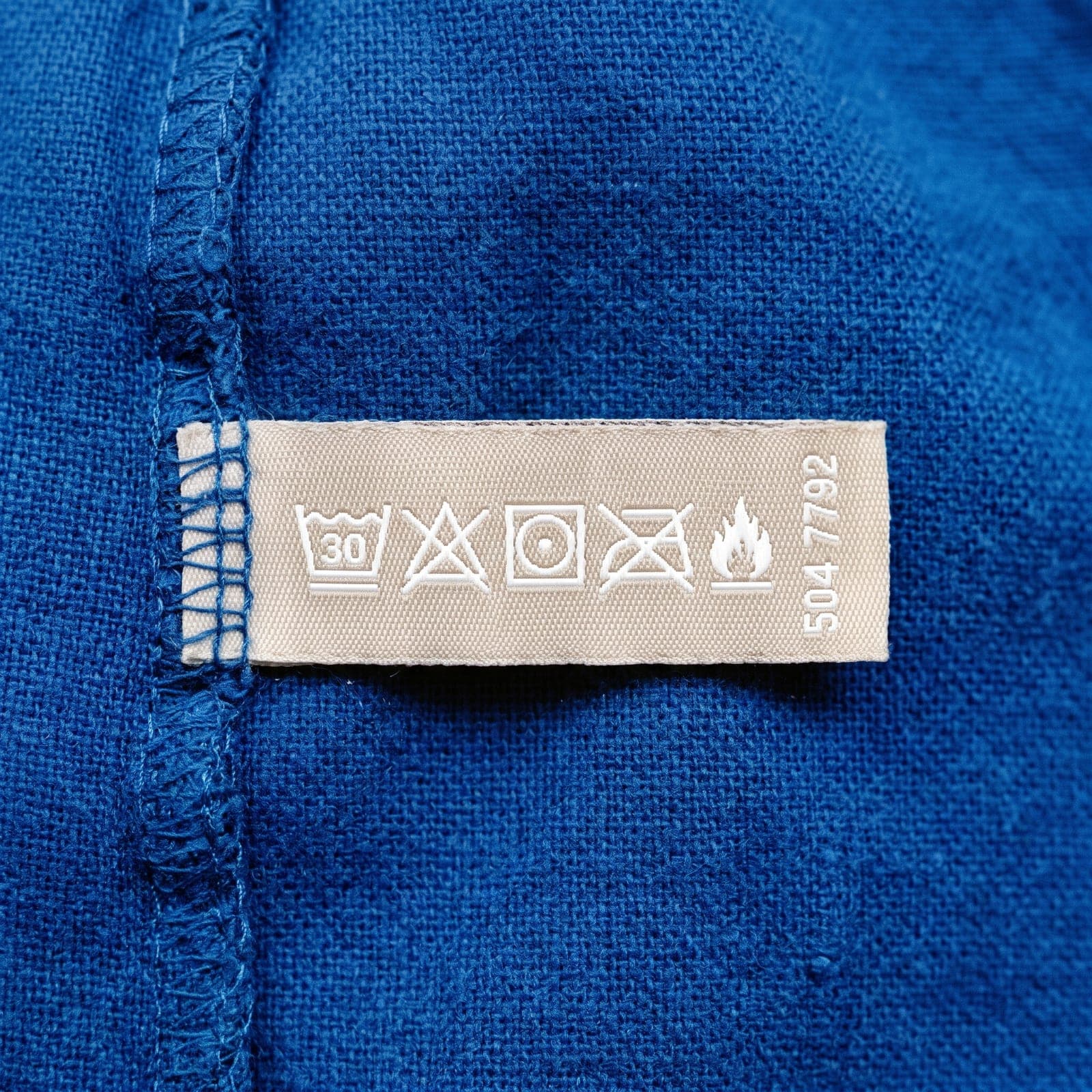
Use the fibre names set out in textile legislation and state the composition. Check readability, language requirements in destination countries and, where relevant, the indication of non-textile parts of animal origin.
Sources: Your Europe · Textile labelling, Regulation 1007/2011 ↗
Materials, dyes and treatments
Check relevant REACH restrictions for fabrics, prints and trims. Connect supplier declarations and testing to the materials actually used. A private certification label does not replace the regulatory assessment.
Sources: European Commission · REACH, Regulation 1907/2006 ↗
Safety and traceability
Prepare the safety assessment, product and operator identification, and the distance-selling information required by the GPSR. Keep models, suppliers, batches and supporting evidence connected.
Documents to collect
- Detailed composition of fabric, linings and trims.
- Label artwork and online product-listing information.
- Material and treatment declarations and relevant test reports.
- Safety assessment, product references, batches and operator details.
Which documents should you request from a supplier? ↗
Who assesses conformity?
Manufacturers and other operators fulfil the obligations attached to their role. For this ordinary garment, there is no generic CE certificate to obtain. Testing and voluntary certification are evidence whose scope must be examined.
Developments to monitor
Track chemical restrictions and product-specific ecodesign measures. Digital Product Passport requirements depend on applicable product rules: the ESPR framework does not create an identical immediate passport duty for every garment. Also review national end-of-life obligations.
A worked example
Fictional worked example.
A brand launches an existing jacket in a new colour. Fibre composition is unchanged, but the dye and finish differ. Review the new variant and supplier evidence rather than relying only on the first colourway’s report.
How Cleo can help
A product compliance assessment scopes the requirements and evidence for your product. Product monitoring then tracks the changes that affect it.
Have my product assessed ↗ · Explore product monitoring ↗
Official sources
- Your Europe · Textile labelling, Regulation 1007/2011 ↗
- European Commission · REACH, Regulation 1907/2006 ↗
- EUR-Lex · GPSR, Regulation 2023/988 ↗
- European Commission · Digital Product Passport ↗
- Your Europe · CE marking ↗
Sources consulted on 5 November 2026. Product configuration, your business role and destination countries determine the assessment needed.
Frequently asked questions
Which products does this article cover?
- Consumer clothing without protective or electronic functions. Identify materials, treatments, trims, intended users and destination countries. Children’s clothing also needs a safety assessment suited to its use.
Who is involved in the conformity assessment?
- Manufacturers and other operators fulfil the obligations attached to their role. For this ordinary garment, there is no generic CE certificate to obtain. Testing and voluntary certification are evidence whose scope must be examined.
Sources & references
Related resources

From 10 October 2026, EU law caps PFHxA at 25 parts per billion in clothing, footwear and accessories: the same short-chain PFAS that suppliers adopted to replace the long-chain chemicals Brussels restricted a decade earlier
On 10 October 2026, Commission Regulation (EU) 2024/2462 starts restricting PFHxA, its salts and PFHxA-related substances in clothing, footwear and accessories sold to the general public in the EU, at 25 ppb and 1,000 ppb respectively, measured per homogeneous material rather than as a finished-product average. PFHxA is the short-chain PFAS much of the outerwear and footwear industry adopted to replace long-chain PFAS like PFOA and PFOS after the EU restricted those roughly a decade ago. Non-clothing textiles and leather get until 10 October 2027; firefighting foam was already covered from 10 April 2026.read ↗